
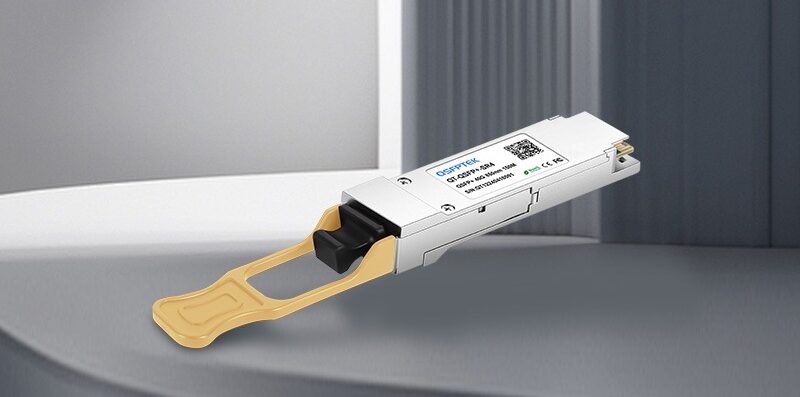
As data centers continue to evolve toward higher port density and east–west traffic patterns, Top-of-Rack (ToR) architectures remain a foundational design choice. While 100G and 400G optics dominate new hyperscale builds, 40G SR4 still plays a practical role in high-density ToR deployments, particularly in legacy environments, cost-sensitive networks, and phased upgrade scenarios. Understanding where 40G SR4 excels, and where it introduces limitations, is essential for informed network design.
Why 40G SR4 Fits High-Density ToR Environments
One of the primary advantages of 40G SR4 is its parallel optics architecture. Using four 10G lanes over multimode fiber, SR4 delivers higher bandwidth per port compared to single-lane 10G optics while maintaining relatively low power consumption. For ToR switches with limited power and cooling budgets, this balance can be attractive.
In high-density racks, port consolidation is another key benefit. Replacing four 10G SR links with a single 40G SR4 connection reduces the number of switch ports consumed on aggregation or spine layers. This can simplify switch configurations and improve overall port utilization, especially in environments where switch expansion is constrained.
From a cost perspective, 40G SR4 remains economically viable in many existing data centers. The optics are mature, widely supported, and typically less expensive than newer 100G solutions. When combined with existing multimode fiber infrastructure, SR4 enables bandwidth upgrades without a complete overhaul of cabling systems.
Cabling Efficiency and Rack-Level Density
High-density ToR deployments often prioritize short-reach connections, making SR4’s typical 100m reach over OM4 fiber more than sufficient. MPO-based cabling allows multiple fibers to be bundled into a single connector, reducing cable bulk in crowded racks. When properly managed, this can improve airflow and simplify physical cable routing compared to multiple duplex LC connections.
Additionally, SR4 aligns well with breakout scenarios, where a 40G port can be mapped logically to four 10G lanes in specific architectures, providing flexibility during incremental upgrades.
The Trade-offs: Where 40G SR4 Falls Short
Despite its advantages, QSFP+ SR4 introduces several trade-offs that become more pronounced in high-density ToR environments. The most notable is cabling complexity. MPO/MTP connectivity requires strict attention to polarity, fiber mapping, and cleanliness. In dense racks, troubleshooting MPO links can be more time-consuming than traditional LC-based connections.
Another limitation is scalability. While 40G SR4 offers a step up from 10G, it does not align as naturally with modern 25G/100G upgrade paths. Many organizations now favor 25G server connections and 100G uplinks, making 40G an architectural middle ground rather than a long-term solution.
Port density at the switch level is also a concern. A single 100G port can often replace multiple 40G ports, reducing optics count and simplifying network tiers. In very high-density ToR designs, this efficiency can outweigh the lower initial cost of 40G SR4.
When 40G SR4 Still Makes Sense
40G SR4 remains a strong option in brownfield data centers, mixed-speed environments, and scenarios where existing OM3/OM4 infrastructure must be reused. It is particularly well-suited for short-reach ToR-to-spine links where cost control and power efficiency are priorities.
Conclusion
In high-density ToR deployments, 40GSR4 offers a practical balance of bandwidth, cost, and power efficiency, but not without compromises. While it cannot match the scalability and simplicity of newer 100G solutions, it continues to deliver value in specific, well-defined scenarios. The key lies in understanding both its strengths and its limitations, and deploying it where it truly fits the network’s operational and upgrade strategy.
 John
John