
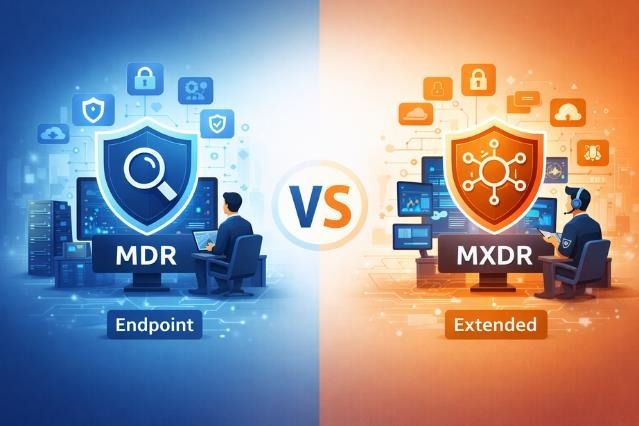
Security tools rarely fail because of a lack of tools. They fail because attackers move faster than detection and response processes can keep up. In many firms, threats are detected after the damage has already been done. And it’s often buried under thousands of alerts that no one had time to investigate properly.
This reality has forced many organisations to outsource detection and response services. But, as these services keep evolving, many leaders face a critical decision – MDR or MXDR? Both promise constant monitoring and expert-led response, they vary greatly in scope, visibility and impact.
Understanding these differences is very important if you are to choose a model that actually benefits you instead of adding complexity.
This blog post will help explain the differences between the two concepts and provide some practical advice on how to make a choice.
What MDR is Designed to Deliver
To understand the difference between MDR and MXDR, it’s important to start with the former.
MDR service where an outside team of human experts watches your devices (computers, laptops, and servers) 24/7.
It provides the following capabilities:
- 24/7 monitoring and alert investigation
- Human analysis of threats for validation
- Incident response guidance or execution
- Less dependence on internal SOC personnel
For many firms, MDR is a significant improvement over tools-only security operations.
What MXDR adds to regular MDR
MXDR builds on the MDR model by adding more data sources and connections.
Think of it as a more advanced service that watches everything. It uses the same team of experts but gives them extra tools to see across your entire digital landscape.
MXDR usually includes signals from:
- Endpoints
- Network and firewall logs
- Identity and access systems
- Cloud and SaaS platforms
- Email and web security tools
This broader view makes it easier to find attack chains that span multiple environments.
Detection Capabilities: Single-Layer vs. Cross-Layer
Detection quality is often the deciding factor in MDR vs. MXDR tests.
MDR excels at detecting:
- Malware and ransomware
- Endpoint-based compromise
- Known attacker techniques
MXDR strengthens detection by identifying:
- Identity misuse and privilege escalation
- Lateral movement across systems
- Low-and-slow attack patterns
- Coordinated attacks using multiple vectors
For organisations facing identity- and cloud-centric threats, this distinction is critical.
Response Scope and Containment Differences
Response capabilities also differ significantly between MDR vs. MXDR.
MDR response typically includes:
- Endpoint isolation
- Malware removal
- Guided remediation steps
MXDR response extends to:
- Identity access control changes
- Network and cloud containment
- Coordinated remediation across platforms
- End-to-end incident orchestration
The broader response scope of MXDR becomes valuable as environments grow more complex.
Operational Fit: Which Organisations Benefit From MDR
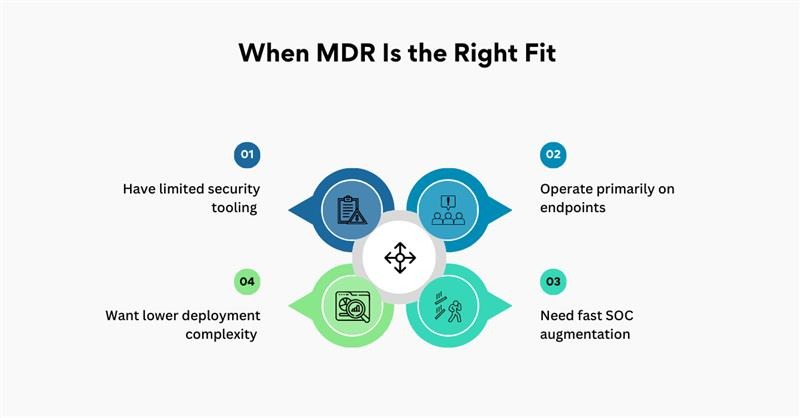
MDR is often well suited for organisations that:
- Have limited security tooling
- Operate primarily on endpoints
- Need fast SOC augmentation
- Want lower deployment complexity
In the MDR vs. MXDR comparison, MDR provides faster time-to-value and lower operational overhead for simpler environments.
Operational Fit: When MXDR Becomes the Better Option
MXDR is typically a better fit for organisations that:
- Operate hybrid or cloud-first infrastructures
- Rely heavily on identity and SaaS platforms
- Use multiple security tools across layers
- Experience complex or persistent threats
In these cases, MDR alone may leave visibility gaps that MXDR is designed to address.
Costs and Value Considerations
When people talk about the costs of MDR vs. MXDR, they often focus on prices instead of results.
MXDR usually costs more up front and takes more work to set up, but it can:
- Find problems sooner to cut down on dwell time
- Stop multi-stage attacks from getting worse
- Lower long-term incident impact
On the other hand, MDR is a cheap way to set up basic detection and response skills.
Common Mistakes When Choosing Between MDR And MXDR
Companies often have a hard time making decisions about MDR vs. MXDR because of avoidable mistakes.
Some of these are:
- Choosing MXDR without enough logging or telemetry
- Expecting MDR to protect against threats to identity and the cloud
- Underestimating integration and operational effort
- Choosing based on feature lists of features instead of how much risk they pose
If you are able to align the service scope with real attack scenarios, it can help you avoid these problems.
Viewing MDR and MXDR as a Maturity Journey
For many firms, MDR vs. MXDR should not be a one-time decision.
A common path is:
- Begin with MDR to make detection and response more stable
- Make processes and visibility better
- Move to MXDR as threats and environments change
This step-by-step method lets security features grow along with the business.
Next Steps
When deciding between MDR and MXDR, organisations should first look at their current attack surface, telemetry coverage and internal response capacity. The right choice depends less on service labels and more on how attacks actually unfold in the real world.
CyberNX is a cybersecurity firm that offers continuous, 24/7 cyber threat detection and response services. They help you in recognising threats, listing possible dangers, conducting analysis and improving attack surface management. They also provide a customised “uniview” threat management platform that gives real-time access to security dashboards and ticket reporting.
Conclusion
Ultimately, the choice boils down to your scope, complexity and readiness. MDR gives strong foundational detection while MXDR builds on that foundation by giving broader visibility and deeper correlation for complex, multi-layer environments.
Security leaders who understand these differences can choose the model that aligns with their current needs and supports their future growth. In the landscape of coordinated attacks, choosing the right detection and response approach is a strategic business decision and you must make it wisely.